For smart home and home automation installers
Home automation installation business software for smart home installers, from the first visit to after-sales support
Smart home projects are personal. Customers want lighting scenes, curtains, door phones and Wi-Fi that simply work, and they will call you whenever something does not. CamVerion keeps the enquiry, quote, installation and every support call for each home in one place.
Plans from ₹999 a month + GST for up to 10 users. Every feature on every plan.
Smart home projects run long and change often
A home automation job can start months before the customer moves in, change as the interior design changes, and depend on electricians and carpenters finishing their part first. Quotes go through several revisions, and after handover the customer calls about a scene that stopped working or a new phone that needs setting up.
Home automation business software keeps every version of the quote, every visit and every support call against the customer, so whoever picks up the phone knows exactly what is installed in that home.
One flow, from first call to final payment
Each stage creates what the next one needs, so nothing is typed twice.
-
Step 1
Enquiry
Capture enquiries from showrooms, architects, interior designers and WhatsApp as leads with a status.
How it works -
Step 2
Home visit
Book a visit to walk the rooms. Notes on switches, curtains and network points feed the quote.
How it works -
Step 3
Room-by-room quote
Start from saved packages, such as a 3BHK lighting package, and adjust room by room.
How it works -
Step 4
Order and jobs
An approved proforma creates the purchase and installation jobs, ready to schedule around the site.
How it works -
Step 5
Scheduling
Plan wiring, fitting and programming visits around the other trades, with each technician's day visible.
How it works -
Step 6
Invoice
Invoice each stage or the whole project from the order, with nothing typed twice.
How it works -
Step 7
Payments
Track advances and stage payments, and see what is due before the final handover.
How it works -
Step 8
Support calls
Log support requests after handover, assign a technician and keep the home's full history.
How it works
Quote with confidence
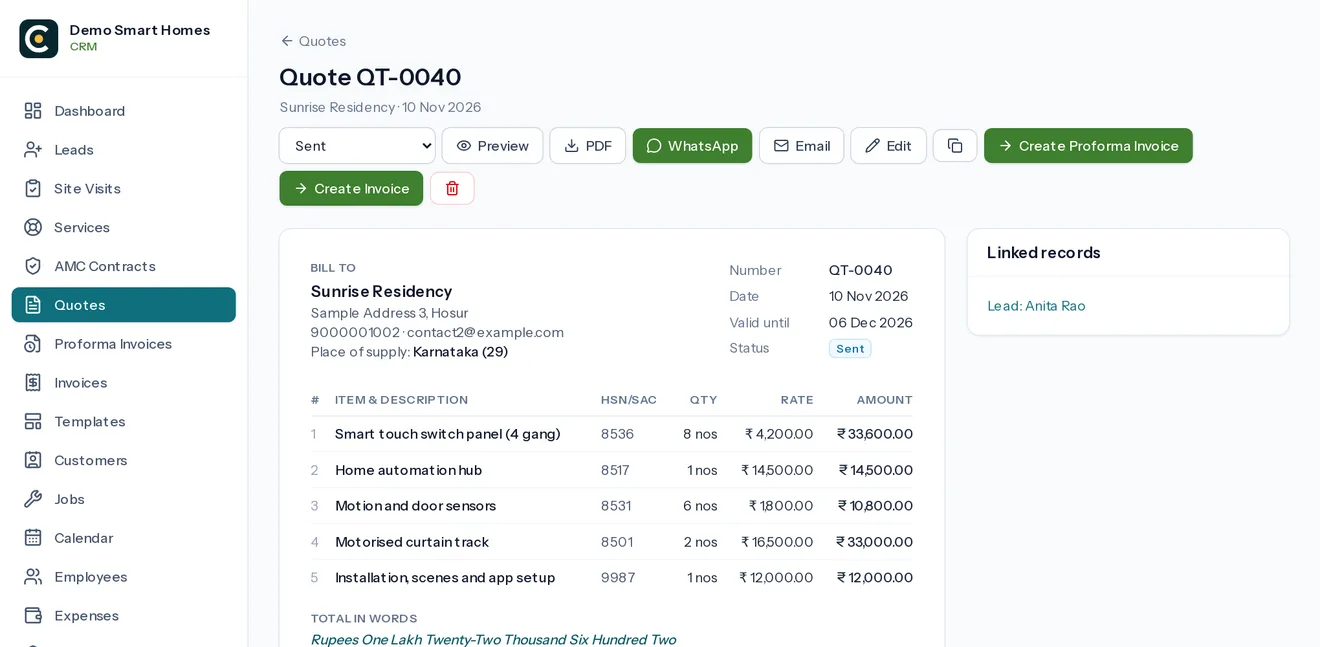
Revisions without the confusion
Customers change their minds as the interiors take shape. Each quote is saved with its items and totals, so you always know which version was approved and what it included.
- Saved packages for common homes and rooms
- Your logo, terms and signature on every PDF
- Turn the approved quote into a proforma in one click
Support after handover
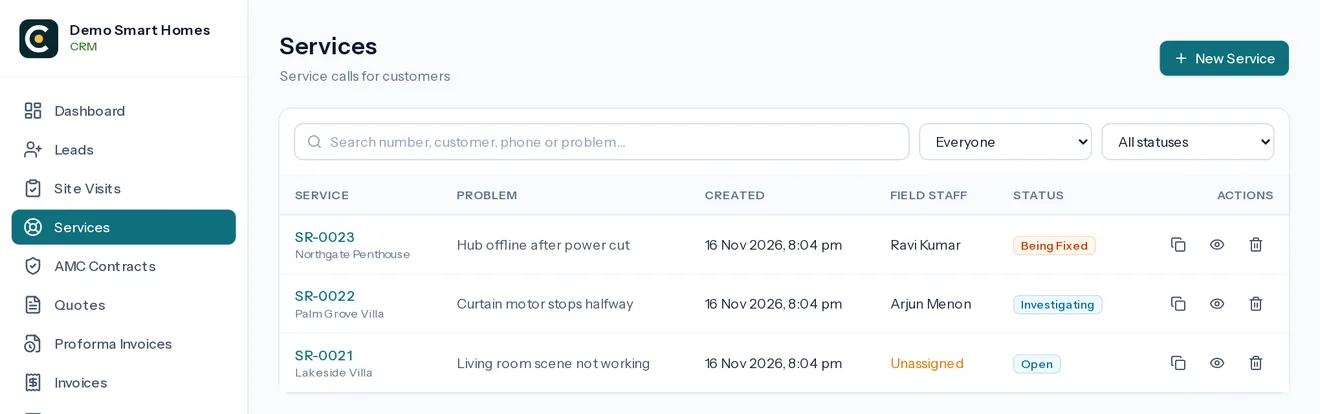
Every support call has an owner
After handover, support requests are logged as service calls with a status, an assigned technician and a record of what was done, so no customer is left waiting.
- See every earlier visit to the same home
- Record chargeable visits and parts
- Send a receipt when the work is done
Screens are from the real software, with made-up demo data.
Everything your home automation business uses day to day
-
Enquiries from every source
Homeowners, architects, interior designers and builders, each with a source and a next step.
-
Home walk-throughs
Room-by-room notes on switches, curtains, sensors and network points.
-
Room-by-room quotes
Saved packages such as a 3BHK lighting package, changed as the design changes.
-
Project jobs
Wiring, fitting, programming and handover as separate jobs on one project.
-
Technician calendar
Programming visits booked around the electrician and carpenter.
-
Support calls
Scenes that stopped working, offline hubs and new phones to set up, each followed to the end.
-
Maintenance contracts
Yearly check-ups and firmware visits created from each contract.
-
Service request link
Homeowners send support requests themselves, with their location.
-
Field staff tracking
Punch in, Capture Location at each home, and the Locations report.
-
Hours per project
Start Work and End Work show how long programming really takes.
-
Stock of switches and hubs
Optional inventory of panels, hubs, sensors and curtain motors.
-
Stage payments
Advance, mid-project and handover payments on one customer record.
Field team tracking
Know where your smart home technicians are, and the hours they really worked
Smart home projects involve many short visits to the same home: first fix, fitting, scene programming, handover and support. With punch in, Capture Location and Start Work on each job, you can see which visits happened, how long programming really took, and price the next project on facts.
-
Capture Location
Your smart home technicians press Capture Location on their phone, and the office sees where they were and when on the Locations report. Ask them to capture it at every client, or every hour, so you can check visits at random instead of phoning around. -
Punch in and out with location
Attendance starts with a punch in that records the time and place, and ends with a punch out. A forgotten punch out closes automatically at the end of the day, so the attendance report is ready for payroll. -
Start Work and End Work on each job
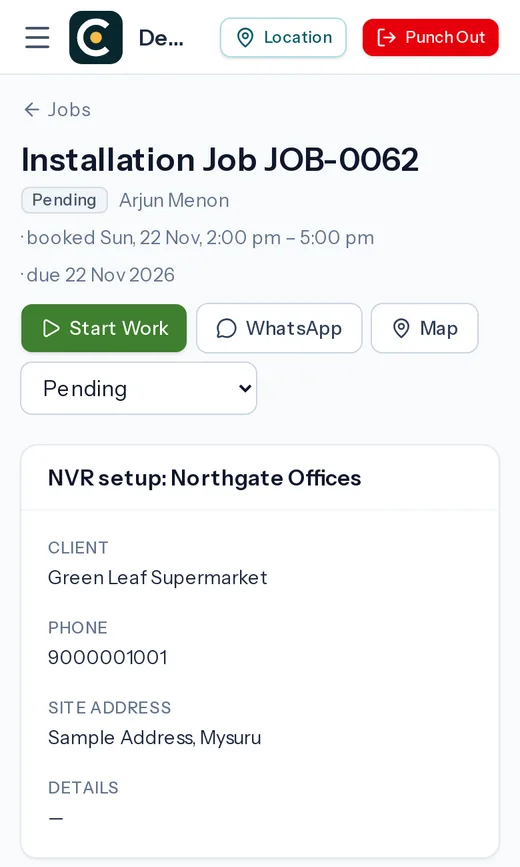
Pressing Start Work on a job or service call starts the clock and End Work stops it. Admins see the hours each person spent on each job, so you can price the next one properly and spot hours that were claimed but not worked. -
Approve new device login
Switch it on, and each person can sign in only from their one approved phone or computer. A login from any other device waits for the admin's approval, so logins are not shared and attendance is marked by the right person. Choose field staff only, or everyone except admins.
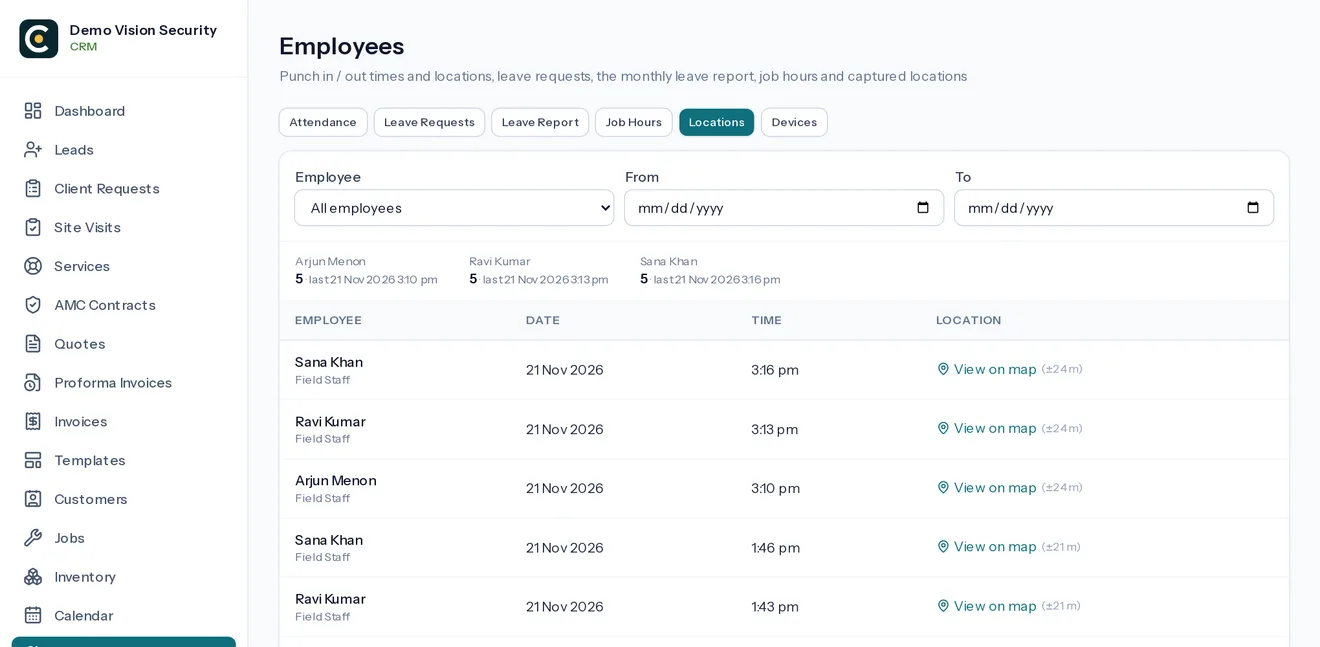
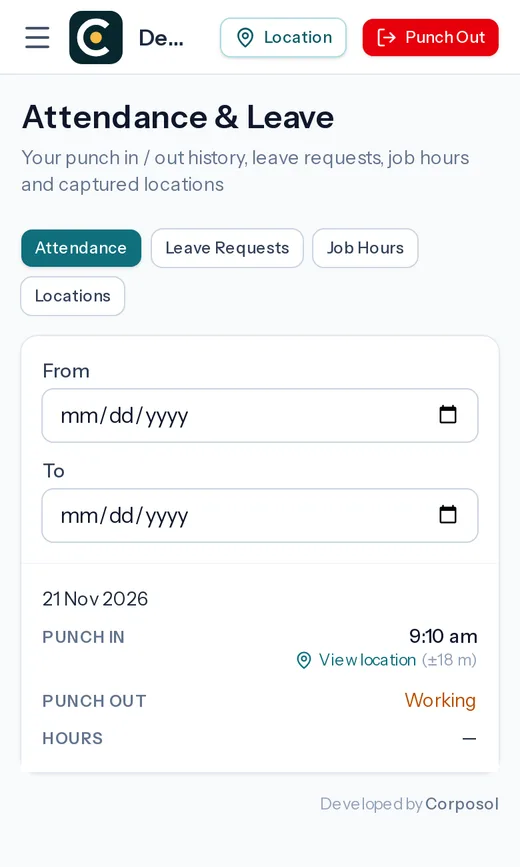
Locations are taken only when staff punch or press Capture Location, never in the background. How field staff tracking works
Built for field teams
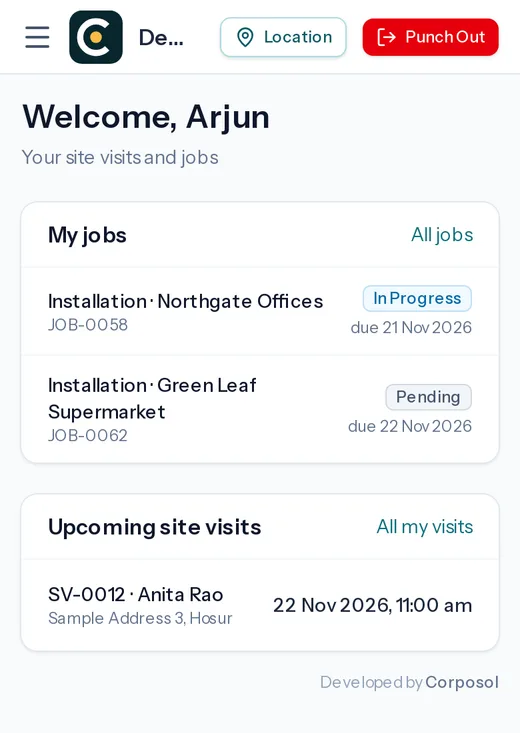
Technicians see the home, not your prices
Your technicians open their visits and jobs on their phone, with the address, contact and notes. They punch in, add photos of wiring and panels, and record the hours each job really took.
How roles workOnline service request form
Clients raise home automation service requests themselves
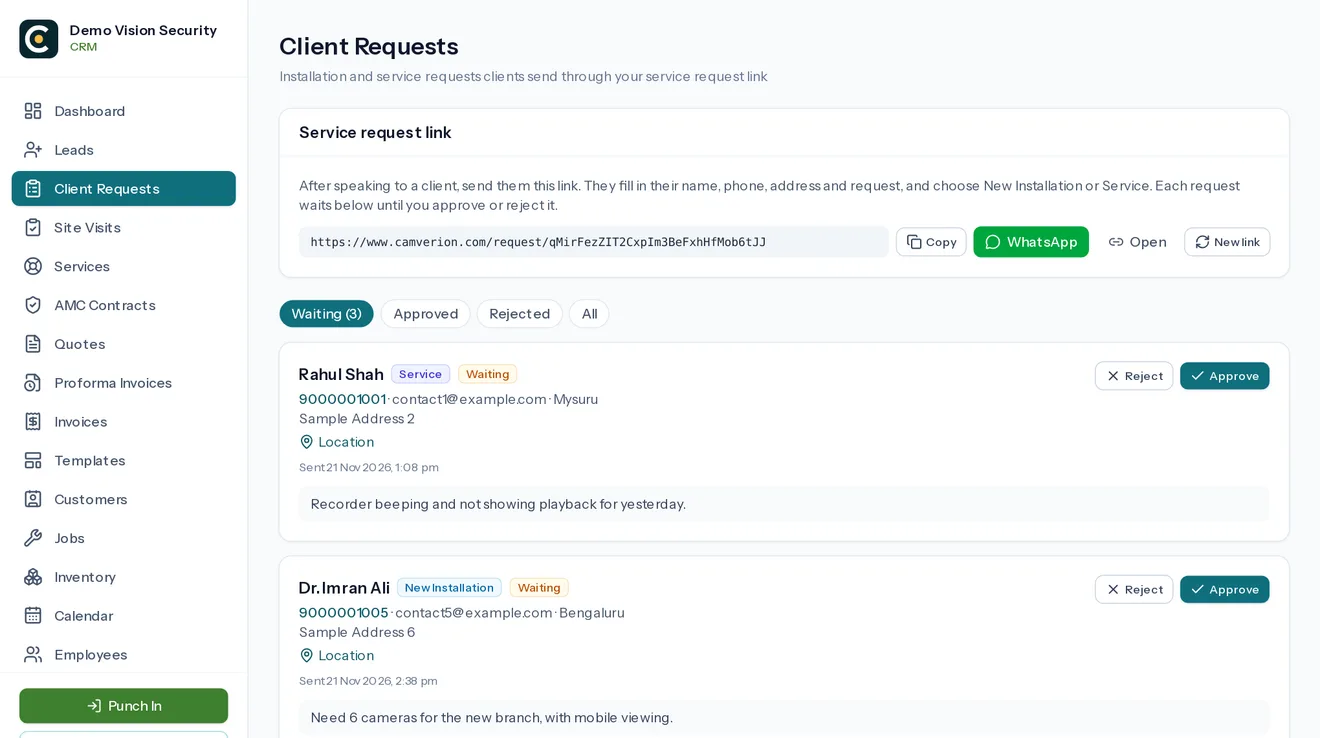
After handover, homeowners call about a scene, a curtain or a new phone. Send them your service request link instead. They describe the problem, paste their Google Maps location, and the request becomes a support call when you approve it.
- Your own link and form with your company name and logo
- Google Maps location required, so the technician goes straight to the site
- Approve a new installation into Leads, or a fault into Leads and Services in one click
- Every admin is emailed from your own company mailbox, once you add it
- Reject spam without it ever reaching your leads
Inventory, when you want it
Stock that is charged to the job that used it
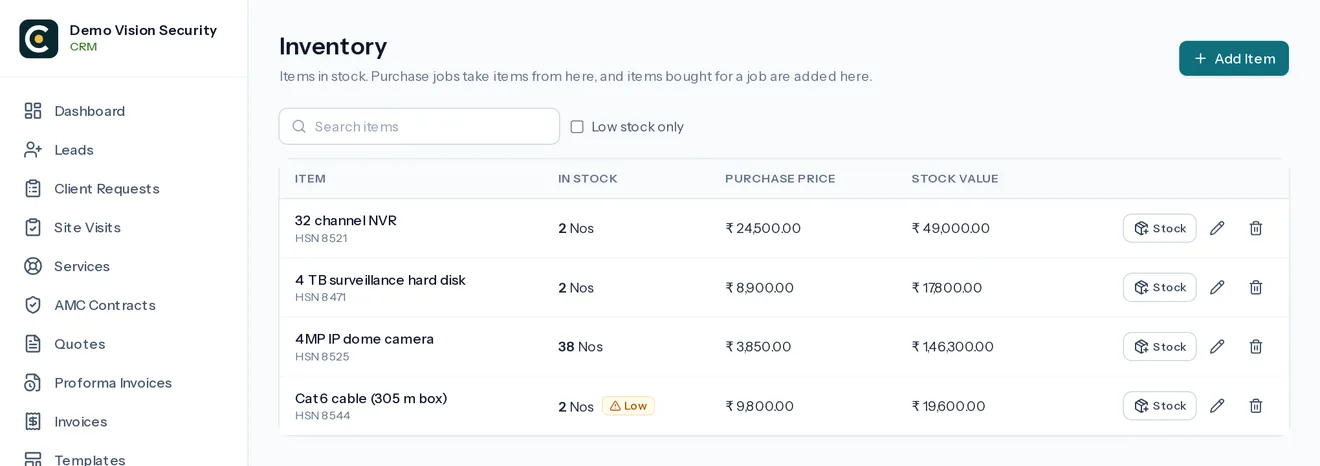
Switch on Inventory to keep switch panels, hubs, sensors, smart locks and curtain motors in stock. Each project takes what it needs, technicians record what they fitted, and returned items go back on the shelf for the next home.
- Stock bought and corrections after counting, each with a note
- Low stock warnings for the items you use on every job
- Items taken from stock or bought new on each purchase job
- Unused items go back into stock when the installer records what was used
- Off by default: companies that do not hold stock never see it
A smart home project, from the architect's call to after-sales support
How a typical home automation project moves through the software.
-
1. Enquiry
An architect sends a client your way. You add the lead with the architect as the source and a follow-up date.
-
2. Home visit
A technician walks every room, notes switch positions and network points, and captures the location.
-
3. Quote
You start from the 3BHK package, adjust room by room, and send version two after the design changes.
-
4. Project jobs
The proforma creates the purchase and installation jobs. Switch panels come out of stock; programming visits are booked on the calendar.
-
5. Handover
The finished project is approved, invoiced from the proforma, and the final payment recorded.
-
6. Support
A scene stops working. The homeowner uses your request link, and the call is assigned with the home's full history.
A good fit for
Teams of about 2 to 50 people, with an office and staff working at customer sites. Every plan includes every feature.
- Smart home and home automation installers
- Lighting control and motorised curtain specialists
- Smart lock and video door phone installers
- Home automation dealers with an installation team
- Integrators working with architects and interior designers
- Companies offering yearly smart home support plans
- Installers who also do home theatre or Wi-Fi
- Teams of 2 to 50 people
Questions about home automation installation business software
What is home automation business software?
It is software that runs a smart home installation company: enquiries from customers and designers, home visits, quotes, installation jobs, invoices, payments, support calls and the staff who do the work.
Is it smart home installation software or a smart home app?
It is smart home installation software for the business: enquiries, home visits, room-by-room quotes, project jobs, technicians and support calls. It is not an app that controls the devices.
Does it connect to smart home systems?
No. CamVerion runs your business, not the devices. It does not control lights or read device status. You keep using each brand's own programming tools for that.
Can architects and designers be tracked as lead sources?
Yes. Each lead has a source, so you can see how many enquiries and how much work each designer, architect or showroom brings.
Can we use it for CCTV and networking work too?
Yes. Smart home companies often install cameras, door phones and Wi-Fi as well. All of it runs through the same leads, quotes and jobs.
How much does it cost?
Plans start at ₹999 a month for up to 10 users, with a one-time setup fee. Every plan includes every feature.
Can I see how long programming and handover really take?
Yes. Technicians press Start Work and End Work on each job, and the Job Hours report shows the time spent per job and per person.
Can homeowners send support requests themselves?
Yes. Send them your service request link. They describe the problem and share their location, and you approve it into a support call.
Can I stop technicians from logging in on other phones?
Yes. Switch on device approval, and each person can sign in only from their approved phone. A new phone needs the admin's approval.
Further reading for home automation business owners
Who it is for
Also built for these installation and service businesses
Different trades, the same journey: an enquiry, a site visit, a quote, the installation, the invoice and years of service. One field service management system runs it for all of them.
- CCTV installation software Surveys, multi-camera quotes, installation jobs and service calls. See how it works
- Security installation software Alarms, access control, intercoms and fire alarm work. See how it works
- Smart home installation software Smart home projects, room-by-room quotes and support. See how it works
- AC and HVAC installation software AC installations, service visits, AMCs and breakdown calls. See how it works
- RO water purifier installation software Purifier installations, filter changes, AMCs and service calls. See how it works
- Solar and inverter installation software Roof surveys, rooftop projects, inverters, batteries and O&M. See how it works
- AV installation business software Equipment quotes, AV projects, calibration and support. See how it works
- Network installation business software Structured cabling, Wi-Fi projects and support calls. See how it works
- Electrical contractor software Wiring projects, panels, EV chargers and maintenance call-outs. See how it works
- IT and computer service business software Computer AMCs, printer and laptop repairs, office IT support. See how it works
- Appliance repair business software Repair calls, warranty jobs, spare parts and service centres. See how it works
- All industries Can't find your industry? Tell us how you work, and we will set it up or build it for you. See all industries
Run your next installation job from one place
Sign up with your company details and pay online. Your account opens as soon as you have paid, and you can add your team.